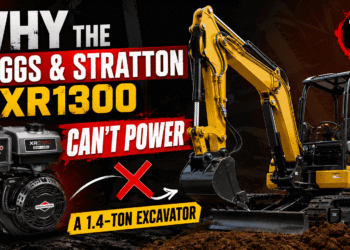

Why the Briggs & Stratton XR1300 Can’t Power a 1.4-Ton Excavator
If you’ve been shopping for a compact excavator and you’ve come across a listing powered by a Briggs & Stratton XR1300, it’s worth slowing down before you buy. On paper, 13.5 horsepower sounds like a reasonable number — it even sits at the low end of the horsepower range you’d expect for a small excavator. But horsepower on a spec sheet and horsepower that survives real digging conditions are two very different things.
Here’s the honest engineering picture of why this engine, no matter how it’s marketed, is not built to run a genuine 1.3, 1.4, or 1.5-ton mini excavator — and how to spot a machine that’s been mislabeled.
The Horsepower Number Is Misleading You
The XR1300 is a 420cc single-cylinder gasoline engine, originally designed for generators, pressure washers, tillers, and other light-duty utility equipment. Rated horsepower tells you almost nothing about whether an engine can survive the way an excavator actually works. What matters is torque delivery under sudden load, sustained duty cycle, lubrication design, and cooling architecture — and this is where the XR1300 falls apart.
Five Mechanical and Thermal Failures Waiting to Happen
1. Torque Collapse Under Load Excavator hydraulic pumps don’t pull a steady load. They spike hard the moment a bucket hits compacted soil or a track stalls against resistance. Small diesel engines are built for exactly this — they hit peak torque low, around 1,800–2,200 RPM, and hold it flat across the range. The XR1300 does the opposite: its roughly 28.5 Nm of peak torque only shows up near the top of its RPM band. The instant a hydraulic spike hits, engine speed drops, torque disappears with it, and the engine stalls.
2. Splash Lubrication Fails on a Slope The XR1300 relies on a Dura-Lube splash system — an internal slinger that flings oil around as it dips into the sump. That works fine on a flat generator pad. It does not work on a digging site. Excavators regularly operate at 20–30 degree angles, and at that tilt, a splash-lubricated engine simply stops feeding oil to the cylinder wall and bearings. Catastrophic failure can happen within minutes. Real excavator diesels use pressurized oil pumps and deep, baffled sumps specifically to prevent this.
3. Heat Has Nowhere to Go Air-cooled engines need open airflow to shed heat. But a 1.4 or 1.5-ton excavator houses its engine inside a sealed steel compartment for protection — which is exactly the wrong environment for a single-cylinder gas engine running near full duty cycle. The heat gets trapped, oil breaks down faster, and gasoline can vapor-lock in the fuel lines before it even reaches the carburetor.
4. Bearings Built for the Wrong Job Excavator hydraulic pumps are usually coupled directly to the flywheel shaft or driven through a heavy belt system, which puts serious axial and radial force on the crankshaft. The XR1300’s PTO bearings were designed for light loads — a generator head or a tiller gearbox, not a multi-stage hydraulic pump. That mismatch wears out main bearings and crank seals fast.
5. A Governor That’s Too Slow to React Digging requires a governor that opens the throttle before RPM drops under load. Utility gas engine governors weren’t built for that kind of responsiveness. Every time you move a pilot control lever, you’ll feel the engine lag, bog, or stall while the governor tries to catch up.
What a Real 1.4-Ton Excavator Actually Needs
A genuine 1.4-ton excavator runs a triple-pump hydraulic system, or a variable displacement axial piston pump, pushing 30–40 L/min at 170–200 bar (2,500+ PSI). Driving that kind of pressure without stalling requires continuous high-torque output — not a peak horsepower number measured on a test bench. Machines like the Kubota KX014 or CAT 301.4 solve this with a 3-cylinder diesel producing 18–24+ HP, a pressurized lubrication system, and a frame built to carry over 3,000 lbs. The XR1300 was never in that conversation.
The Real Reason Some “1.4-Ton” Excavators Are Cheap
This is where the tonnage confusion usually starts. Machines built around the 13.5 HP Briggs & Stratton XR1300 are, in reality, 1-ton class micro-excavators — typically 800 to 975 kg (1,750–2,150 lbs) operating weight. That’s noticeably lighter than the 600–700 kg mini excavators you’ll sometimes find at auction, and far below the 3,000+ lbs of a true 1.4-ton machine.
A few things drive the mislabeling:
- Shipping weight gets confused with operating weight. Sellers round up box or crate weight and market it as machine tonnage.
- Model names get read as specifications. Names like “DM-13,” “H13,” “HY14,” “1.4 Ton,” or “1.3T” are model designations, not verified operating weights — but importers often let buyers assume otherwise.
- The serial plate tells the truth. If you check the actual operating weight stamped on the machine, it will typically read under 1,000 kg (2,200 lbs), regardless of what the listing title says.
Bottom Line
A 13.5 HP Briggs & Stratton XR1300 will comfortably dig in a home backyard or handle light trenching. What it will not do is survive as the engine in a genuine 1.4-ton industrial mini excavator. If you’re evaluating a listing that pairs this engine with a “1.4-ton” or “1.5-ton” label, check the operating weight on the serial plate before you trust the marketing copy. The mismatch between advertised tonnage and real specifications is common enough in the gray-market import space that it’s worth five minutes of verification before you commit to a purchase.
FAQ (Structured for Featured Snippets / AI Overviews)
Can a 13.5 HP Briggs & Stratton XR1300 power a mini excavator? It can power a light-duty 1-ton class micro-excavator for basic backyard digging, but it cannot reliably power a genuine 1.3, 1.4, or 1.5-ton mini excavator. It lacks the low-RPM torque, pressurized lubrication, and cooling needed for sustained hydraulic loads.
Why do mini excavators use diesel engines instead of gasoline? Diesel engines deliver peak torque at low RPM and hold it across a flat curve, which matches the sudden load spikes from hydraulic pumps. Small gasoline utility engines peak at higher RPMs and stall when hit with those same spikes.
How do I check if my “1.4-ton” excavator is really 1.4 tons? Check the operating weight on the machine’s serial plate. A true 1.4-ton excavator weighs over 3,000 lbs (about 1,400 kg). If the plate reads closer to 800–1,000 kg, the machine is actually in the 1-ton class regardless of what the model name or listing says.
Why does my mini excavator engine stall when I dig into hard ground? This usually points to a torque deficit and a slow-reacting governor — common in gasoline utility engines not designed for excavator hydraulics. The engine can’t maintain RPM under the sudden load spike, so it bogs down or stalls.