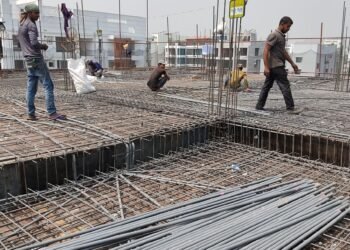

Why Concrete Fails Even When the Design is Absolute best
A structurally sound design does now not ensure sturdiness. Some of the overpassed reasons of failure in bolstered concrete buildings is fallacious compaction.

Throughout world building tasks, deficient compaction ends up in:
- Honeycombing
- Inside voids
- Lowered bond power
- Lengthy-term sturdiness problems
Even a high-strength combine design turns into useless if entrapped air isn’t got rid of correctly. Conventional vibration strategies rely closely on hard work ability, consistency, and web page stipulations, making high quality keep watch over tricky.
This elementary limitation ended in a big innovation in concrete era.
What You Will Be told
How self-compacting concrete (SCC) works with out vibration
The elemental concept of Bingham fluid habits in easy phrases
Key SCC checks like hunch drift and T50
How SCC achieves drift, filling, and compaction by itself
The place and why SCC is utilized in trendy building
The Beginning of Self-Compacting Concrete
Within the past due Nineteen Eighties, Jap researchers, specifically Okamura and Ozawa, addressed the rising factor of insufficient compaction because of hard work shortages and extending structural complexity.
They presented a idea that redefined concrete placement:
A concrete that might drift, fill, and compact underneath its personal weight with out vibration.
This innovation become referred to as Self-Compacting Concrete (SCC).
What’s Self-Compacting Concrete?
Self-Compacting Concrete is a high-performance concrete designed to:
- Go with the flow underneath its personal weight
- Fill formwork totally
- Cross thru congested reinforcement
- Get rid of the desire for mechanical vibration
- Handle balance with out segregation or bleeding
In sensible phrases, SCC behaves like a fluid throughout placement however keeps the mechanical houses of hardened concrete after environment.
The Core Engineering Problem
The improvement of SCC required fixing a elementary contradiction: Concrete should be fluid sufficient to drift freely, but strong sufficient to forestall segregation.
If the combination is just too fluid, coarse aggregates separate. Whether it is too viscous, it fails to drift thru reinforcement. The answer lies in controlling the rheological habits of concrete.
Bingham Fluid Principle in SCC
The drift habits of SCC is recurrently modelled the use of the Bingham fluid equation:
The place:
- τ = shear tension
- τᵧ = yield tension
- μₚ = plastic viscosity
- γ̇ = shear fee
Yield Rigidity (τᵧ)
This represents the minimal tension required to begin drift. In SCC, yield tension is deliberately stored low in order that gravity on my own can cause motion.
Plastic Viscosity (μₚ)
This controls how the concrete flows after motion starts. It should be moderately balanced:
- Low viscosity ends up in segregation
- Prime viscosity ends up in blockage
The good fortune of SCC is determined by reaching an optimum stability between those two parameters.
How Self-Compacting Concrete Works
1. Aid of Combination Interplay
SCC accommodates a decrease share of coarse aggregates. This reduces particle collision and interior friction, permitting smoother drift.
2. Particle Dispersion The use of Superplasticizers
Trendy SCC depends upon high-performance superplasticizers, specifically Polycarboxylate Ether (PCE)-based admixtures.
Examples used globally come with:
- Sika ViscoCrete®
- MasterGlenium (Grasp Developers Answers)
- Fosroc Auramix
Those admixtures:
- Disperse cement debris
- Scale back water call for
- Toughen flowability considerably
3. Formation of a Lubrication Layer
SCC mixes comprise upper fines and powder content material. This creates a paste-rich matrix that bureaucracy a lubrication layer round aggregates.
Because of this:
- Aggregates slide as a substitute of interlocking
- Go with the flow turns into steady and regulated
4. Viscosity Keep watch over The use of Admixtures
Viscosity Enhancing Admixtures (VMA) are every so often added to deal with balance.
Their function is to:
- Save you segregation
- Handle uniform distribution
- Toughen cohesiveness
What Occurs Throughout Placement
Go with the flow Initiation
The self-weight of concrete generates tension exceeding the yield tension, beginning drift in an instant with out vibration.
Filling Talent
The concrete flows thru congested reinforcement and complicated geometries, making sure entire filling.
Self-Leveling and Air Unencumber
Entrapped air escapes naturally as the combination flows, leading to a dense and uniform construction.
The important thing theory is: Compaction happens throughout drift, now not after placement.
Workability Exams for SCC
In contrast to typical concrete, SCC is evaluated the use of specialised checks.
1. Hunch Go with the flow Check
- Measures horizontal unfold
- Standard vary: 650–800 mm
- T50 Time = Time required to succeed in 500 mm unfold, Standard vary: 2–5 seconds
2. L-Field Check
- Measures passing skill thru reinforcement
3. V-Funnel Check
- Evaluates drift time and viscosity
Those checks make certain that the concrete will succeed in right kind compaction sooner than it’s positioned.
Environment Behaviour of SCC
SCC follows the similar hydration mechanism as typical concrete however presentations other workability traits.
- Preliminary environment time: 2 to five hours
- Ultimate environment time: 6 to ten hours
Because of the presence of superplasticizers:
- Workability is retained for an extended length
- Lack of drift happens reasonably hastily as soon as environment starts
SCC vs Typical Concrete
| Parameter | Typical Concrete | SCC |
|---|---|---|
| Compaction | Exterior vibration | Self-compacting |
| Exertions dependency | Prime | Low |
| High quality consistency | Variable | Prime |
| Workability checking out | Hunch | Hunch drift, L-box |
| Possibility of defects | Upper | Decrease |
International Packages of SCC
Self-Compacting Concrete is extensively utilized in:
- Prime-rise building tasks in america and Heart East
- Precast concrete industries throughout Europe
- Bridge building and infrastructure in the UK
- Tunnels, marine buildings, and architectural concrete
It’s particularly efficient the place vibration is hard, inefficient, or impractical.
Why SCC is No longer Used All over
Regardless of its benefits, SCC has sure boundaries:
- Upper subject matter value because of admixtures
- Strict combine design necessities
- Sensitivity to batching and high quality keep watch over
- Want for skilled technical supervision
Ultimate Perception
Self-Compacting Concrete represents a shift in building method.
As a substitute of depending on exterior compaction, SCC guarantees that:
- Go with the flow initiates robotically
- Filling happens totally
- Compaction occurs inherently
All the procedure is engineered throughout the combine itself.
Learn Extra On: Self-Compacting Concrete vs Customary Concrete: Price, Efficiency & When to Use (2026 Information)
References
- Okamura, H., & Ouchi, M. (2003), Self-Compacting Concrete, https://www.jstage.jst.cross.jp/article/jact/1/1/1_1_5/_article
- EFNARC (2005), The Eu Tips for Self-Compacting Concrete, https://www.efnarc.org/pdf/SCCGuidelinesMay2005.pdf
- Khayat, Okay. H. (1999),Workability, Checking out, and Efficiency of SCC,American Concrete Institute