

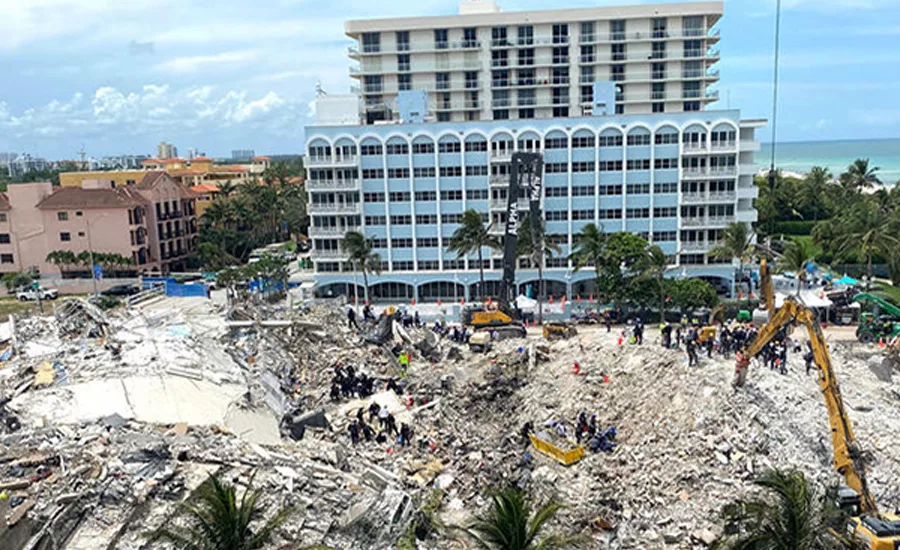
The Nationwide Institute of Requirements and Generation on June 22 launched technical findings and additional main points in regards to the occasions resulting in the cave in of Champlain Towers South and the tragic deaths of 98 folks that befell 5 years in the past.
The company concluded that the cave in series started weeks prior to the construction fell, when two slab-column connections underneath the Surfside, Fla., rental’s pool deck skilled punching-shear disasters, starting up a modern series that culminated within the partial cave in of the 12-story reinforced-concrete tower on June 24, 2021.
“When construction buildings are designed and constructed to required codes and requirements, they have got margins in opposition to failure, which means they will have to be capable to improve a lot more load than they’re anticipated to endure,” Judith Mitrani-Reiser, co-lead of NIST’s Nationwide Development Protection Crew investigation, mentioned in a video presentation accompanying the findings.
“When it comes to Champlain Towers South, then again, those margins in opposition to failure had been too slim from the beginning,” she added.
Cave in Collection Started Weeks Previous
In keeping with the company, the cave in in all probability started in early June 2021, about 3 weeks prior to the tower got here down, when two connections between storage columns and the pool deck slab failed.
The ones preliminary disasters didn’t in an instant cause cave in. As an alternative, surrounding parts of the pool deck and the street-level parking construction briefly absorbed the lots, expanding call for on neighboring connections that had been already prone.
“As soon as the primary connections failed, different parts of the pool deck had been left to hold their lots,” investigators mentioned within the presentation. “However they weren’t robust sufficient to maintain them because of issues that stemmed from the unique design and building of the construction.”
On the lookout for fast solutions on building and engineering subjects?
Check out Ask ENR, our new sensible AI seek software.
Ask ENR →
NIST mentioned the failure unfold during the pool deck and parking construction prior to progressing into the tower itself.
“The low margins in opposition to failure had been basically led to by way of two elements,” investigation co-lead Glenn Bell mentioned. “First, critical and fashionable deviations within the construction’s unique structural design from the codes and requirements of the day, but additionally some barriers in the ones codes and requirements. And 2nd, deviations within the construction’s building from the design drawings.”
NIST mentioned parts of the pool deck and street-level parking slab failed to fulfill code necessities for flexural power and slab-column connection power, with some spaces offering lower than part the specified power.
Investigators additionally discovered building deviations, together with out of place reinforcing metal and less reinforcing bars crossing over columns than required by way of the design.
Bell’s connection with “barriers in the ones codes and requirements” suggests the findings can have implications past Champlain Towers South. Whilst NIST didn’t establish explicit code adjustments in its June 22 findings, the investigation centered closely on slab-column punching-shear conduct, joint efficiency and the interplay between ageing buildings, added lots and long-term deterioration. The company mentioned suggestions for adjustments to codes, requirements and trade practices shall be incorporated in its ultimate document.
Further lots added all over the construction’s existence additional lowered structural capability, in keeping with the company. Those incorporated massive planter packing containers that weren’t proven at the unique drawings, in addition to later rehabilitation paintings that added pavers and sand bedding to parts of the pool deck device.
Lengthy-term deterioration equipped the overall hyperlink within the failure series.
“We discovered no proof of any explicit starting up tournament,” Bell mentioned within the presentation. “The overall issue that introduced the seriously low margins of protection to the purpose of failure used to be in all probability long-term degradation from corrosion.”
NIST mentioned the findings rule out a number of theories that emerged within the aftermath of the cave in, together with within sight building vibration, basis failure, sinkholes, agreement, storm results, explosions and unintended overloads from a roof challenge underway on the time.
The findings construct on NIST’s September 2025 conclusion that the cave in originated within the pool deck.
RELATED
Pool Deck Failure Cited as Beginning Level in Surfside Apartment Cave in
Findings Support Florida Reforms
For Greg Batista, president of Citadel Lauderdale-based G. Batista Engineering & Development, the findings in large part verify patterns he has encountered all over a long time of labor comparing and repairing ageing Florida condominiums.
“Not anything stunned me. Completely not anything in any respect,” Batista mentioned. “Having carried out this for goodbye, you get to look a development, and the development simply repeats itself and repeats itself and repeats itself.”
Batista, who mentioned NIST interviewed him all over the investigation, famous that the findings support considerations engineers have lengthy raised about deferred repairs, deteriorating buildings and the desire for ok investment to handle issues prior to they develop into vital.
In his opinion, the findings additionally improve the explanation in the back of Florida’s post-Surfside rental reforms, together with structural integrity reserve research and expanded inspection necessities enacted after the cave in.
“A very powerful factor that that invoice led to used to be the structural integrity reserve find out about,” he mentioned, relating to the state’s rental protection regulation. “That calls for forums and house owners associations to if truth be told have reserves.”
The requirement used to be designed to scale back the danger that associations defer primary structural upkeep because of insufficient reserve investment, a subject that has drawn heightened scrutiny because the cave in.
NIST mentioned it’ll now get ready its ultimate document, which can come with supporting proof, checking out effects, computational modeling and suggestions for adjustments to construction codes, requirements and trade practices.
The company didn’t supply a unencumber date for that document.