

What Form of Hydraulic Fluid Is Beneficial for Mini Excavators?
What hydraulic fluid is beneficial for mini excavators? Maximum mini excavators run easiest on anti-wear hydraulic oil rated ISO VG 46 in reasonable climates. Chilly-weather jobs most often name for ISO VG 32, whilst sizzling or heavy-duty stipulations would possibly warrant ISO VG 68. Your OEM guide has the ultimate — at all times take a look at it first.
I have observed contractors pour the flawed hydraulic fluid right into a brand-new mini excavator with out pondering two times. Identical tale each time — they grabbed what was once at the shelf, figured hydraulic oil is hydraulic oil, and moved on. 3 months later, they are coping with a slow increase, a pump that whines like a wounded animal, and a restore invoice that makes the eyes water.
Mini excavator hydraulic fluid is not some arbitrary specification buried in a guide no person reads. It is the unmarried fluid your whole system runs on. Each and every dig, each swing, each monitor motion — all of it occurs as a result of pressurized oil is doing precisely what it is meant to do inside of a tightly engineered gadget. Feed that gadget the flawed oil and you might be no longer simply decreasing efficiency. You are quietly burning via parts that charge hundreds of bucks to exchange.
Here is what this information covers: the precise form of hydraulic fluid maximum producers in reality counsel, why viscosity grades subject greater than the general public understand, how ceaselessly you in point of fact wish to substitute it, and the errors that box technicians see over and over on task websites. Whether or not you run one compact system or a complete fleet of them, that is sensible data — the sort that saves you cash ultimately.
Working out Mini Excavator Hydraulic Techniques
Here is one thing a large number of operators do not totally admire: a mini excavator is largely a hydraulic system that occurs to have an engine. The engine’s task is most commonly simply to power the hydraulic pump. The whole thing else—lifting, digging, swinging, touring— runs on pressurized oil.

The pump pulls fluid from the reservoir and pushes it via a community of traces, keep an eye on valves, and hoses. That pressurized fluid reaches the cylinders that transfer your increase, arm, and bucket, plus the motors that power your tracks and swing the home. While you transfer a lever within the cab, you might be directing pressurized oil to do paintings. It is a superbly easy idea that turns into difficult speedy whilst you think about running temperatures, force spikes, and the sheer collection of parts concerned.
What the Fluid Is In truth Doing
On the hydraulic pump: The pump works with inside clearances measured in microns. The oil movie isolating transferring metallic surfaces inside of that pump is the one factor conserving it from destroying itself. If it is too skinny, that movie collapses beneath force. Too thick and the pump has to struggle the fluid to transport it, losing power and producing warmth.
On the cylinders, your increase, arm, and bucket cylinders lengthen and retract hundreds of instances an afternoon. The fluid has to lubricate the seals that preserve force contained. Seals are comprised of particular elastomers that play smartly with sure fluid chemistries—and react badly to others.
On the motors: Observe drives and swing motors convert hydraulic force again into rotation. Those parts are specifically delicate to contamination. Somewhat dust within the fluid turns into an abrasive paste that grinds them down.
On the keep an eye on valves: The spool valves that path oil to other circuits are precision-machined portions. Fluid that is too thick makes them slow. Fluid that carries contamination can make them stick or put on erratically.
Warmth control: Hydraulic fluid additionally carries warmth clear of parts. A fluid that is breaking down thermally stops doing this successfully, which is why overheating and oil degradation generally tend to spiral in combination.
Figuring out all this, it is clearer why mini excavator hydraulic fluid is not one thing to bet on.
What Hydraulic Fluid Is Beneficial for Mini Excavators?
Brief resolution: Anti-wear (AW) hydraulic oil rated ISO VG 46 is what the vast majority of mini excavator producers specify for traditional running stipulations. This covers manufacturers like Kubota, Yanmar, Takeuchi, Bobcat, Caterpillar, and John Deere — all of them land in kind of the similar position for same old use.
What you might be on the lookout for at the product label is fluid that meets this kind of requirements:
- ISO 6743-4 HM — the main world classification for mineral-based anti-wear hydraulic oil
- DIN 51524 Phase 2 HLP — a well known Ecu same old you’ll be able to see referenced in lots of OEM manuals
- Denison HF-0 / HF-1 / HF-2—efficiency specifications some producers cite without delay
When a product meets those designations, it way the components contains an anti-wear additive bundle, rust and oxidation inhibitors, and maintains solid viscosity throughout an inexpensive temperature vary. In observe, you’ll be able to to find AW 46 from manufacturers like Shell Tellus S2, Mobil DTE 25, and Chevron Rando HD—they all formulated to hit those benchmarks.
Does Artificial Hydraulic Fluid Make Sense?
On occasion. Top rate man made and semi-synthetic hydraulic fluids truly do carry out higher in particular scenarios:
- Prolonged oil existence: High quality synthetics dangle up longer earlier than breaking down, which will stretch substitute periods significantly—with lab research to make sure.
- Chilly-start coverage: Synthetics keep fluid at decrease temperatures, which reduces the unpleasant cavitation possibility all through the ones first short while after a chilly beginning.
- Thermal balance: In high-cycle, high-heat programs, synthetics face up to oxidation higher than mineral oils.
The catch is value. Artificial hydraulic fluid prices 3 to 5 instances extra in keeping with gallon than standard mineral AW 46. For a system operating conventional industrial hours in reasonable stipulations, high quality mineral oil is totally good enough and a ways less expensive. Synthetics earn their preserve if you find yourself operating onerous in temperature extremes or looking to stretch repairs periods on a big fleet.
Working out Hydraulic Fluid Viscosity Grades
Viscosity is only a measure of ways thick or skinny a fluid is—in particular, how a lot it resists flowing. In a hydraulic gadget, viscosity determines whether or not the oil can care for a protecting movie between metallic surfaces beneath force, how a lot the pump has to paintings to transport it, and the way the gadget responds to temperature adjustments.
The ISO VG (Viscosity Grade) gadget assigns a bunch in line with the fluid’s kinematic viscosity measured in centistokes (cSt) at 40°C. Upper quantity way thicker fluid.
| Viscosity Grade | Viscosity at 40°C | Best possible Temperature Vary | Primary Merit | Conventional Use |
| ISO VG 32 | ~32 cSt | -20°C to 40°C (-4°F to 104°F) | Flows freely in bloodless climate | Wintry weather operations, bloodless climates |
| ISO VG 46 | ~46 cSt | -10°C to 50°C (14°F to 122°F) | Balanced year-round efficiency | Usual mini excavator paintings |
| ISO VG 68 | ~68 cSt | 0°C to 60°C (32°F to 140°F) | Higher movie energy in warmth | Sizzling climates, heavy-duty programs |
Maximum OEMs land on ISO VG 46 as their default advice as a result of it really works reliably around the temperature vary maximum machines come across in commonplace three-season operation. It isn’t best possible for each situation, however it is the most productive all-around selection if you find yourself no longer in temperature extremes.
ISO VG 32 vs ISO VG 46 vs ISO VG 68
Selecting the correct grade is not difficult as soon as you already know what your system goes to stand in the market. Here is a plain-language breakdown.
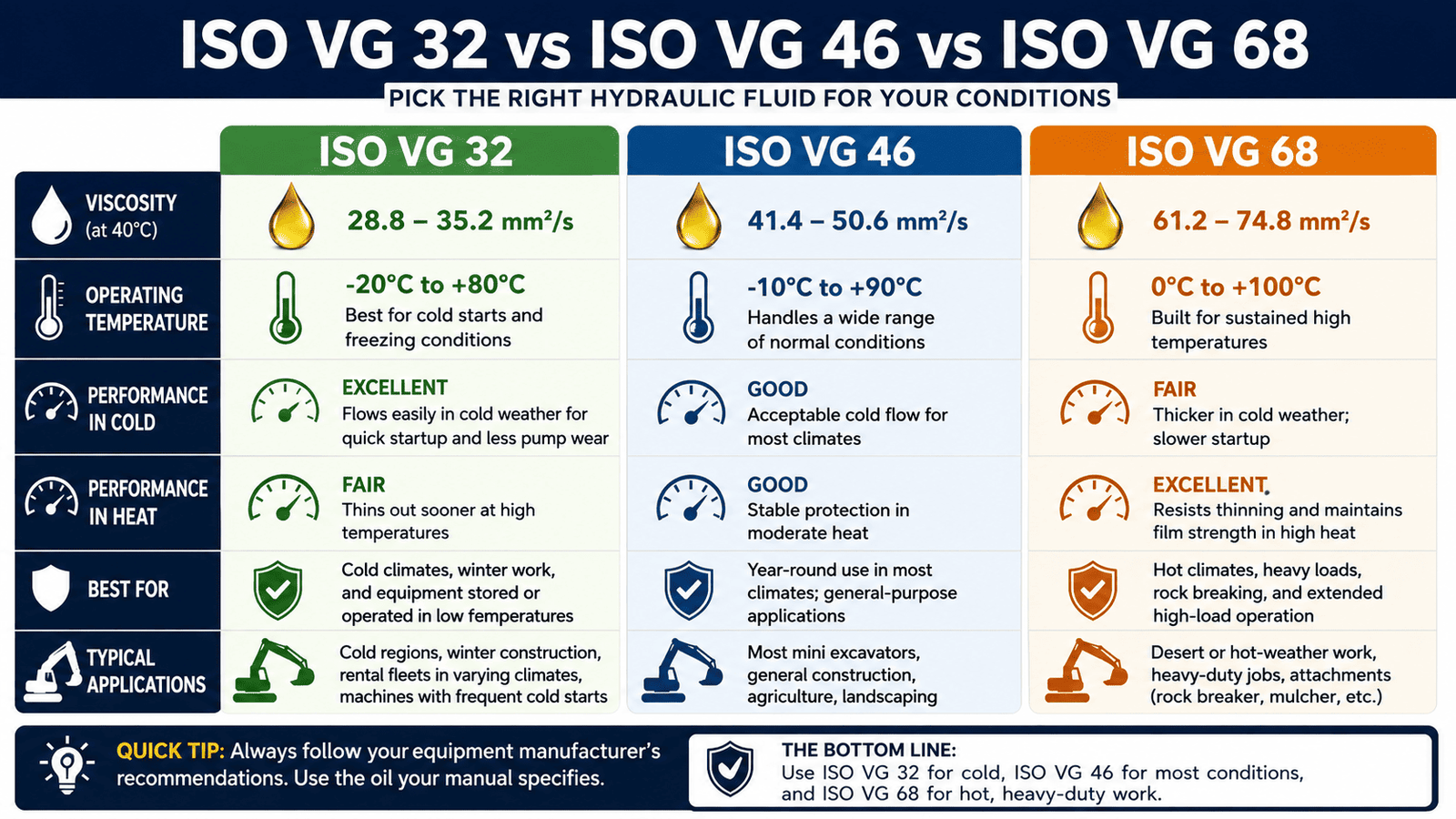
ISO VG 32 — What Chilly-Local weather Operators Want
When temperatures continuously drop under freezing, thinner fluid is the easier selection. ISO VG 32 flows freely even if it is bloodless, which is important all through startup. Here is why that issues: when a hydraulic pump begins spinning, it wishes oil instantly. If the fluid is just too thick to waft into the pump speedy sufficient, the pump in brief runs dry or pulls in air—a situation known as “cavitation”—and that is the reason truly harmful to pump internals.
In case you are running on task websites the place morning temperatures continuously sit down under -10°C (14°F), ISO VG 32 is value switching to. The trade-off is that lighter-grade oil supplies thinner coverage at upper temperatures, so it isn’t what you wish to have for summer time heavy lifting.
ISO VG 46 — The On a regular basis Usual
That is the grade maximum contractors must default to, and for excellent explanation why. ISO VG 46 handles the entire swing of temperatures you’ll see throughout a regular running 12 months in maximum portions of North The us, Europe, and Australia. It protects the pump, maintains correct seal lubrication, and remains solid throughout reasonable warmth. It is also readily to be had from each primary lubricant provider, which issues when you want it briefly.
In case your operator guide says AW 46, this oil is precisely what that implies. Do not overthink it.
ISO VG 68 — Constructed for Warmth and Punishment
Operating a system in summer time warmth within the wilderness, doing prolonged rock-breaking paintings, or running via lengthy high-load cycles? ISO VG 68 has the viscosity to stick thick sufficient to give protection to parts whilst oil temperatures climb. A lighter fluid thins out because it heats up, in the end getting too skinny to care for good enough movie energy. ISO VG 68 resists that thinning impact longer.
The disadvantage is that it strikes sluggishly when bloodless. Startup on a fab morning with ISO VG 68 within the gadget can really feel stiff, and the pump is doing extra paintings in the ones first short while. It is a trade-off value making if sustained warmth is your larger downside.
Why The use of the Proper Mini Excavator Hydraulic Fluid Issues
This is not a “apply the principles for the sake of it” scenario. The results of operating the flawed fluid are actual, measurable, and dear.
Pump put on occurs speedy with flawed viscosity. Hydraulic pump internals perform with tolerances within the micron vary. The oil movie that helps to keep metallic from contacting metallic is thinner than a human hair. If that movie breaks down for the reason that fluid is flawed — flawed viscosity, flawed additive bundle, flawed chemistry — metal-on-metal touch begins instantly. It is innovative injury. The pump does not fail in a single day, however it is demise slightly with each hour.
Anti-wear components in reality do the heavy lifting. AW-rated hydraulic fluids include zinc dialkyl dithiophosphate (ZDDP) or identical compounds that create a sacrificial coating on metallic surfaces when beneath excessive force. With out those components, high-load moments—hitting onerous subject matter, lifting at capability — put unprotected metallic beneath huge rigidity.
Unsuitable fluid destroys seals. Hydraulic seals are engineered to be chemically appropriate with particular fluid varieties. Run an incompatible fluid and the ones seals swell, harden, or shrink. The result’s leaking cylinders, dripping fittings, and force loss throughout the entire gadget. Changing seals right through a hydraulic gadget is not affordable, and it is solely avoidable.
Viscosity mismatch wastes gasoline. A pump suffering to push thick oil via a chilly gadget is burning extra gasoline than it must. So is a pump that is letting fluid bypass internally as a result of it is too skinny to care for correct sealing. Proper viscosity way the gadget runs at its designed potency level.
Part lifespan is the base line. A hydraulic gadget that will get the appropriate fluid at the proper agenda can truly out survive the remainder of the system. One that does not? You are looking at pump rebuilds, cylinder replacements, and valve paintings lengthy earlier than the hours at the clock counsel you must be.
Indicators Your Hydraulic Fluid Wishes Alternative
Your system generally will provide you with caution earlier than issues get critical. Here is what to stay up for.
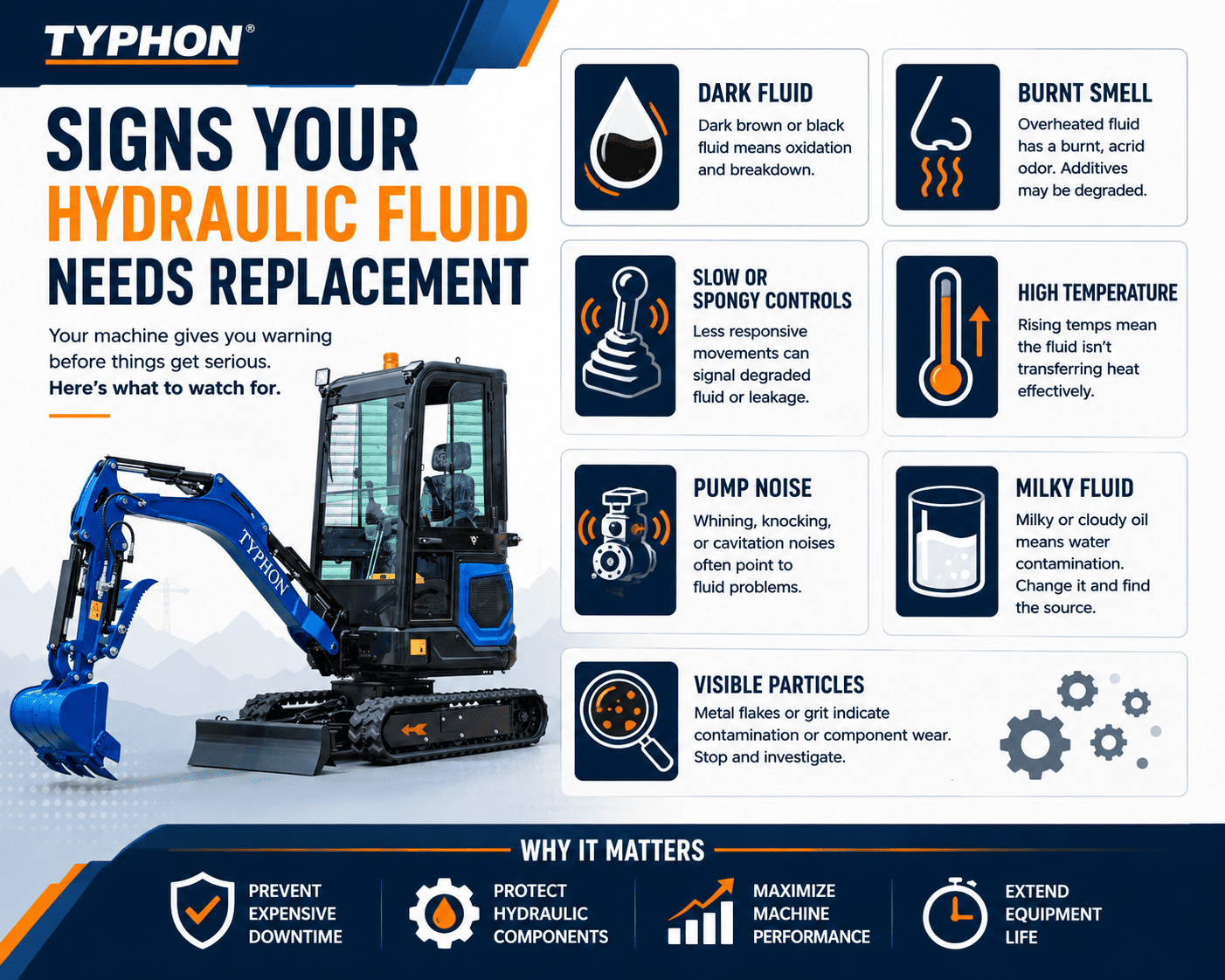
The fluid has long past darkish. Recent hydraulic oil is light amber, from time to time just about transparent. When it begins taking a look brown or black, that is oxidation — the oil has been breaking down thermally and gathering byproducts. When it resembles used motor oil, it must had been changed way back.
There is a burnt odor coming from the reservoir. Overheated fluid develops a definite acrid odor. In case you pull the dipstick and it smells like one thing scorched, the additive bundle has most likely degraded considerably. That fluid is not protective a lot anymore.
Controls really feel sluggish or spongy. When increase and arm actions really feel much less crisp than they used to, deteriorated fluid or inside leakage is a commonplace perpetrator. It might additionally sign an element downside, however degraded oil is ceaselessly the place the diagnostic path begins.
The temperature gauge helps to keep mountaineering. Hydraulic fluid transfers warmth. When it loses that capability — both as a result of it is damaged down or infected — the gadget runs warmer than it must. Repeated overheating occasions boost up additional degradation in a comments loop that is onerous to damage with out converting the fluid.
The pump is making noise it should not. Whining, knocking, or a cavitation sound like gravel in a blender all through startup—all of those level to fluid issues. Generally it is both too thick for chilly stipulations, aerated from a foaming factor, or so degraded it isn’t lubricating correctly.
The fluid appears milky. This one’s pressing. Milky or cloudy hydraulic oil way water has entered the gadget—via a leaking cooler, condensation, or a infected fill. Water in a hydraulic gadget reasons corrosion, promotes microbial enlargement in heat stipulations, and degrades each floor it touches. Exchange the fluid instantly and to find the access level.
You’ll see debris in it. Steel flakes, grit, or the rest that makes the fluid glance cloudy or gritty way both the filter out has failed or an element is breaking down. It is a stop-and-investigate scenario, no longer a change-it-and-keep-going one.
How Frequently Must Hydraulic Fluid Be Modified?
There is not one resolution that matches each scenario, however listed below are the baselines maximum producers and box technicians paintings from.
New machines get an early substitute. Maximum OEMs name for a primary hydraulic fluid and filter out substitute someplace between 500 and 1,000 hours. The reason being break-in: new inside parts shed fantastic metallic debris as they seat, and you wish to have that contamination out earlier than it begins circulating completely.
Usual mineral AW oil: After that preliminary substitute, you might be most often taking a look at each 1,000 to two,000 hours beneath commonplace running stipulations or every year—whichever milestone arrives first. Some operators on lighter-duty programs push towards the longer finish of that vary. Machines running onerous in dusty or sizzling environments must be at the shorter finish.
Condominium fleets and heavy-use apparatus: If the system runs more than one shifts, works steadily in competitive stipulations, or sees a large number of other operators, a conservative manner — 500 to at least one,000 hours — makes extra sense. The price of fluid is trivial in comparison to sudden part screw ups.
Artificial fluids: Top rate synthetics can legitimately lengthen drain periods to a few,000 hours or past, however you must be operating oil research to make sure the fluid continues to be in spec earlier than extending. Do not take the promoting declare at face worth with out exact information out of your system.
Something that should not range: substitute your hydraulic filter out each unmarried time you convert the fluid. Hanging contemporary oil via a saturated filter out defeats all the objective. Go back filters and suction strainers get modified in combination at each period.
Commonplace Hydraulic Fluid Errors to Steer clear of
Those are not hypothetical. They occur on actual task websites each week.
Blending fluid varieties. Even though each merchandise are classified as anti-wear hydraulic oil, components from other formulations can react badly when mixed. You’ll finally end up with sludge, foam, or diminished anti-wear coverage—none of which you’ll be able to understand till the wear is finished. If you want to change merchandise, drain the gadget first.
Grabbing the flawed viscosity grade. Operating ISO VG 68 via a system running in bloodless morning stipulations is calling for pump cavitation. Operating ISO VG 32 via a system doing sustained heavy paintings in summer time warmth is calling for untimely put on. The grade issues. Fit it for your exact stipulations.
Leaving contamination unchecked. Hydraulic contamination is the main reason behind untimely hydraulic part failure industry-wide. Debris which can be invisible to the bare eye scratch precision pump surfaces and jam valve spools. Skipping filter out adjustments, topping off from a grimy container, or leaving the reservoir cap off whilst you take hold of a component—those create contamination issues that silently ruin parts over months.
Ready till one thing breaks. “It is running fantastic” is the most costly philosophy in apparatus repairs. Degraded hydraulic fluid provides no evident efficiency sign till the wear it is been inflicting presentations up as a failed pump or leaking cylinder. By way of that time, you will have paid for the fluid substitute and the restore.
The use of affordable, off-spec oil. This one stings for the reason that financial savings glance actual within the second. Hydraulic oils that do not meet ISO HM or HLP requirements ceaselessly skimp at the anti-wear additive bundle, use lower-quality base shares, or have deficient viscosity balance. The cost distinction in keeping with gallon is not anything in opposition to the price of a hydraulic pump rebuild.
Overfilling the reservoir. Extra is not higher right here. Overfilled reservoirs purpose the oil to foam because the gadget agitates it, and aerated oil is horrible at transmitting force. Fill to the marked degree — no longer previous it.
Hydraulic Fluid Repairs Best possible Practices
None of that is difficult. It simply calls for doing it persistently.
Exchange filters at the similar agenda because the fluid. The go back filter out and suction strainer do not get a separate period — they arrive out when the oil comes out, each time. A plugged filter out bypasses and sends unfiltered oil directly in the course of the gadget.
Pull the dipstick or take a look at the sight glass continuously. You are looking at colour, degree, and whether or not the fluid appears commonplace. Milky oil, a unexpected drop in degree, or the rest that appears off warrants investigation earlier than the following filter out substitute date.
Ship oil samples for lab research. This sounds fancy, however it is reasonably priced and extremely helpful, particularly on machines with vital hours. An oil research file tells you the viscosity, whether or not there are metallic debris (and what kind, which issues to which part is dressed in), water content material, and last additive existence. It is the maximum correct solution to come to a decision whether or not you might be converting fluid too early or too past due.
Transfer grades between seasons if you want to. In case your wintry weather temperatures truly warrant ISO VG 32 and your summer time warmth requires ISO VG 46, make the transfer—however drain and flush utterly fairly than topping one into the opposite.
Retailer fluid correctly. A drum that is been sitting out of doors, uncapped, accumulating rainwater and dirt has no industry going right into a hydraulic gadget. Hydraulic fluid must be saved sealed, indoors or coated, clear of temperature swings. That is elementary stuff that will get skipped extra ceaselessly than it must.
Use blank switch apparatus. Devoted funnels and switch boxes that by no means contact the rest. Topping off a hydraulic reservoir with a container that closing held equipment oil introduces additive incompatibility on best of doable contamination.
Opting for Hydraulic Fluid for Other Operating Stipulations
Chilly Climate Operations
Machines beginning in temperatures under -10°C (14°F) take pleasure in ISO VG 32 or a multi-grade hydraulic oil with a low pour level. Past the fluid selection, permit a real warm-up length—10 to fifteen mins at idle—earlier than hanging load at the gadget. Shifting the system onerous earlier than the oil has reached running temperature is difficult on each hydraulic part, irrespective of which grade you might be operating.
Sizzling Local weather Stipulations
Sustained summer time warmth or tropical task websites push methods towards ISO VG 68. In those stipulations, track the hydraulic temperature gauge and take a look at the fluid situation extra ceaselessly—warmth accelerates oxidation. When the system sits all through breaks, shading it reduces the thermal load at the fluid sitting within the reservoir.
Heavy Building Websites
Rock breaking, steady heavy lifting, and demolition paintings — those programs create extra warmth and force biking than conventional excavation. Imagine top class mineral or man made AW 46 or 68 and pull fluid research extra steadily. The more difficult you push a hydraulic gadget, the quicker the fluid degrades.
Landscaping Packages
Landscaping paintings is relatively delicate on hydraulic methods—reasonable lots, shorter day-to-day running hours, and extra numerous actions. Usual mineral AW 46 handles this smartly. The larger fear in landscaping environments is contamination from natural particles getting close to fill issues or the reservoir cap.
Condominium Apparatus Fleets
Condominium machines are the Wild West of repairs histories. Operators apply other behavior, machines get returned with undiagnosed problems, and it is truly tough to understand precisely what situation any given unit’s hydraulic gadget is in. For fleet managers, conservative substitute periods — irrespective of what the fluid seems like — and a normal oil research program provide the easiest likelihood of catching issues earlier than they transform primary screw ups.
Professional Suggestions for Mini Excavator House owners
After spending time round compact apparatus on actual task websites, a couple of issues stand out as persistently true.
Your OEM guide is the primary record you must learn, no longer the closing. Producers like TYPHON Equipment engineer their hydraulic methods round particular fluid parameters. The guide spells out precisely which viscosity grades, efficiency classifications, and from time to time particular fluid varieties are required. Deviating from the ones specifications — even with a high quality fluid that turns out identical on paper — can void guaranty protection and cut back the reliability of a gadget that was once designed to paintings a selected manner.
Stick to established lubricant manufacturers. Shell, Mobil, Chevron, Overall, and identical providers have many years of formula historical past and authentic high quality keep an eye on. In some markets, counterfeit or diluted lubricants are an actual factor — one more reason to shop for from licensed vendors fairly than unknown on-line dealers.
Motor oil isn’t a change. Ever. You would be shocked how ceaselessly this comes up. Motor oil has the flawed additive bundle for hydraulic methods, incompatible viscosity habits, and can degrade your seals. No matter what grade it’s or how high quality the logo is. Objective-formulated hydraulic fluid simplest.
Construct a dating along with your broker. Whether or not you might be operating TYPHON apparatus, Kubota, Bobcat, or the rest, your licensed broker provider division has the OEM documentation and sensible enjoy to substantiate the appropriate fluid on your particular system and your particular running stipulations. It is a telephone name that prices not anything and will prevent from a dear mistake.
Stay written repairs information. Each and every fluid substitute, each filter out, each oil research is logged with date and hours. That is truly helpful when one thing is going flawed, as a result of you’ll hint again precisely when repairs was once finished. It additionally protects you commercially: documented repairs historical past helps resale worth and is helping in guaranty discussions.
Key Takeaways
- ISO VG 46 anti-wear hydraulic oil is probably the most extensively specified grade for mini excavators operating in same old stipulations.
- ISO VG 32 fits bloodless climates; ISO VG 68 fits sizzling or sustained heavy-duty programs.
- Fit your fluid specification to what your OEM guide in reality says — no longer simply normal steering.
- Exchange mineral hydraulic fluid each 1,000–2,000 hours; at all times change the filter out on the similar time.
- The 3 maximum harmful hydraulic repairs errors are blending fluid varieties, operating the flawed viscosity, and ignoring contamination.
- Oil research is probably the most cost-effective repairs instrument for extending periods and catching early part put on.
Ceaselessly Requested Questions
What hydraulic fluid is easiest for mini excavators?
For many operators running in reasonable stipulations, a top quality anti-wear hydraulic oil rated ISO VG 46 that meets ISO 6743-4 HM or DIN 51524 Phase 2 HLP requirements is the appropriate name. In case you are continuously running in bloodless temperatures, ISO VG 32 handles bloodless begins higher. For sustained warmth or heavy-duty cycles, ISO VG 68 supplies a thicker protecting movie. Your OEM guide will specify which grade is proper on your particular system.
Can I exploit any hydraulic oil in a mini excavator?
No, and that is the place other folks get themselves into bother. Mini excavators want fluid that meets the efficiency specifications within the OEM guide — the appropriate viscosity grade and the appropriate additive bundle. Generic hydraulic oils that do not meet ISO HM or HLP requirements, motor oil used instead, or fluid of the flawed viscosity can all injury seals, boost up pump put on, and purpose gadget screw ups which can be pricey to position proper.
What’s the distinction between ISO VG 32, 46, and 68?
The quantity is the viscosity—how thick the fluid is at 40°C. ISO VG 32 is the thinnest of the 3 and flows simply in bloodless stipulations, making it excellent for cold-climate startups however much less protecting at excessive temperatures. ISO VG 46 sits within the center and handles a large temperature vary smartly, which is why it is the usual advice for many mini excavators. ISO VG 68 is the thickest and gives higher coverage when temperatures climb however strikes sluggishly when bloodless.
How ceaselessly must mini excavator hydraulic fluid be modified?
Maximum producers counsel an preliminary substitute between 500 and 1,000 hours on new machines, then each 1,000 to two,000 hours for same old mineral oil beneath commonplace running stipulations. Machines running in heavy-duty or sizzling environments must be at the shorter finish. Top rate synthetics can stretch periods additional with common oil research. Annual adjustments are an inexpensive baseline for machines that do not at all times hit the hour thresholds.
Can hydraulic fluid expire?
It will possibly, particularly when saved poorly. Components can separate through the years, moisture can infiltrate sealed boxes, and base oil oxidation can start even earlier than the drum is opened. Correctly sealed and saved hydraulic fluid usually remains usable for 2 to 5 years, however at all times check out it earlier than the usage of fluid that is been sitting for some time. If it appears hazy, smells off, or has any sediment, do not possibility it.
Can I combine other hydraulic oils?
That is one to steer clear of. Two fluids of the similar viscosity grade from other producers could have additive programs that react badly when mixed—inflicting sludge, foam, or diminished anti-wear efficiency. If you want to change manufacturers or fluid varieties, drain and flush the gadget first. Topping up a just about empty reservoir with a distinct product turns out innocuous however can create issues through the years.
What viscosity must I exploit for my mini excavator?
Get started with the operator guide—that is the specification your system was once constructed round. ISO VG 46 is the commonest advice for same old stipulations throughout maximum manufacturers. In case you are running in authentic cold-weather stipulations continuously, ISO VG 32 will provide you with higher cold-start coverage. For warm, heavy-duty programs, ISO VG 68 is value bearing in mind. In case you are undecided, your apparatus broker can verify the appropriate grade on your particular system and surroundings.
How a lot hydraulic fluid does a mini excavator dangle?
It varies reasonably somewhat via system measurement. Small 1 to two ton machines may have reservoirs within the 15 to 30 liter vary. Better compact excavators within the 5 to eight ton magnificence most often dangle 60 to 100 liters or extra. Please take a look at the specs phase of your operator guide, as this is the place the precise reservoir capability on your style is indexed.
Can bloodless climate impact hydraulic fluid efficiency?
Completely, and it is one of the vital extra underappreciated ways in which apparatus can get broken. Chilly oil is thick oil, and thick oil does not waft into the pump speedy sufficient all through startup. This will purpose cavitation — the pump in brief pulling in air fairly than fluid — which damages inside pump parts all of a sudden. Operating ISO VG 32 in bloodless stipulations and giving the system a correct idle warm-up length earlier than loading it considerably reduces this possibility.
What occurs if hydraulic fluid will get infected?
Infected hydraulic fluid is in the back of a good portion of untimely hydraulic screw ups. Cast debris as small as 10 to fifteen microns—invisible to the bare eye—rating pump surfaces and injury valve spools. Water contamination reasons rust, promotes bacterial enlargement in heat stipulations, and strips away the lubricating homes of the fluid. In case you suspect contamination, drain the gadget, flush it, change the filters, and learn how it took place earlier than refilling.
Conclusion
Here is the object about mini excavator hydraulic fluid—it is a type of subjects that turns out like regimen repairs minutiae proper up till it is not. The system that is been operating completely for 1,800 hours does not come up with a lot caution when degraded or wrong fluid begins catching up with it. Pump substitute, cylinder seal kits, keep an eye on valve paintings — those maintenance occur, and they are infrequently affordable.
Selecting the proper fluid is truly easy as soon as you will have learn the textual content a ways. ISO VG 46 anti-wear hydraulic oil handles nearly all of mini excavator programs. In case you are in a chilly nation, use ISO VG 32. In sustained summer time warmth with heavy paintings, ISO VG 68 is the appropriate selection. Purchase from a model that in reality meets the spec, substitute it on time, change the filter out each unmarried time, and preserve the gadget blank.
The contractors and fleet managers who get probably the most out in their apparatus over the lengthy haul are not doing the rest unique. They are constant. They apply their OEM suggestions, they do not minimize corners on fluid high quality, they usually keep forward of repairs as a substitute of reacting to screw ups.
Test your guide. Use the appropriate fluid. Exchange it on time. That is in point of fact all there may be to it—and it makes a huge distinction over the lifetime of a system.


![[Video] Kioti Enters Compact Excavator Marketplace with 3 Fashions](https://machineryasia.info/wp-content/uploads/2026/10/index-20260331-010319-DP-Podcast-TemplateKioti-350x250.jpg "[Video] Kioti Enters Compact Excavator Marketplace with 3 Fashions")