
Mammoet, the Dutch heavylift and particular shipping corporate, has finished the relocation of the long-lasting Kiruna Church, considered certainly one of Sweden’s maximum precious architectural landmarks.
Greater than 1,000 hours of making plans went into the operation, which came about over two days. Kiruna is certainly one of Sweden’s maximum northerly towns, about 150km north of the Arctic Circle.
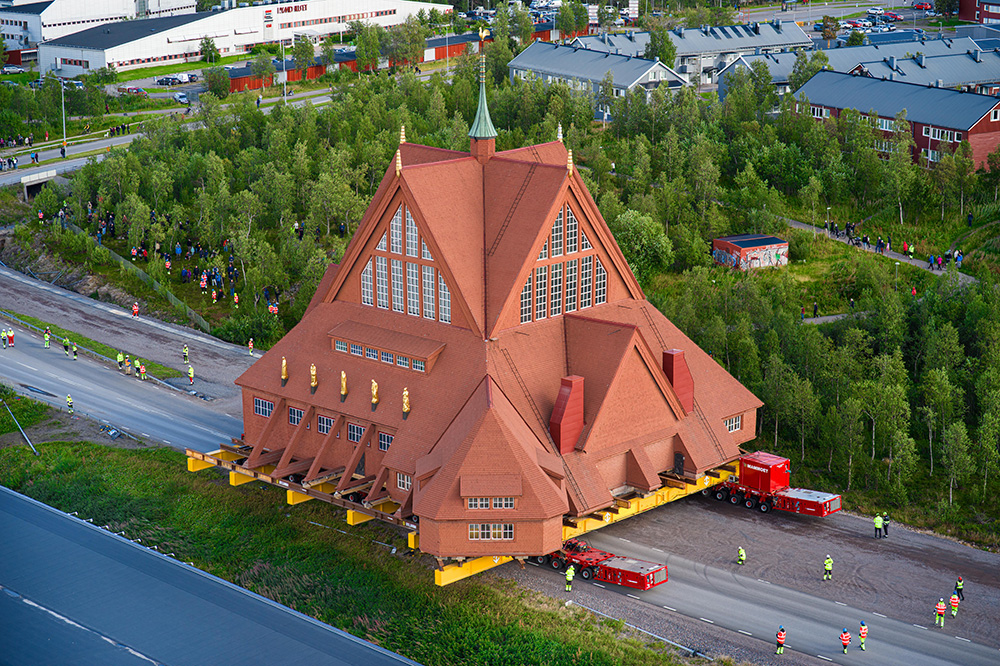
The church, which measures 40m x 40m, stands 37m tall and weighs 670 tonnes, used to be moved to its new location on two of Mammoet’s 28-axle self-propelled modular transporters (SPMTs) with a load capability of 48 tonnes consistent with axle. The entire operation used to be broadcast are living by means of Sveriges Tv as ‘gradual TV’.
Constructed within the early 20th century and as soon as voted Sweden’s most pretty development, Kiruna Church is likely one of the nation’s biggest picket buildings. It used to be constructed within the outdated town centre and needed to be moved (or demolished) due standard subsidence led to by means of Kiruna’s underground iron ore mine.
The Kiruna mine is the sector’s biggest underground iron ore mine and is owned and operated by means of LKAB – Luossavaara-Kiirunavaara Aktiebolag – the Swedish state-owned mining corporate. After a long time of mining task, all the town centre is now in danger from flooring motion; a number of different constructions have already been demolished and reassembled at a brand new town centre this is being advanced 5km away.
Mammoet used to be commissioned by means of LKAB and its civil engineering contractor Veidekke to move the picket church in a single piece. The transfer, dubbed “The Nice Church Stroll,” drew hundreds of spectators, together with Sweden’s king Carl Gustav, in addition to the TV cameras.

Mammoet labored with Veidekke and Swedish picket engineering consultants to style and check the development’s reaction to lifting and shipping. The operation used to be timed for August to keep away from adversarial climate prerequisites that would jeopardise the transfer.

The church used to be jacked as much as a top of one.3 metres and put on metal beams supported by means of two trains every comprising 28 axle traces of self-propelled modular transporters (SPMTs). Mammoet’s customized tracking gadget ensured the construction remained strong all the way through the adventure, taking into account a most tilt of simply 75mm between facets.
After a blessing by means of vicar Lena Tjärnberg and Åsa Nyström, bishop of the Diocese of Lulea, Mammoet began its trailers and the church activate previous the crowds that had collected to witness the development.

Direction arrangements integrated transient highway widening and compacting paintings. Mammoet suggested at the civil works and performed highway assessments the use of SPMTs loaded with counterweights to simulate the church’s axle load.
The relocation came about all through sunlight hours on 19th and 20th August 2025, with the church arriving safely at its new location. As soon as in position, the SPMTs decreased the construction onto its new concrete foundations.
Mammoet has since relocated the church’s 90-tonne belfry the use of a special SPMT configuration.
“This challenge exemplifies the significance of detailed engineering and making plans in executing distinctive and significant strikes,” stated Mammoet challenge supervisor William Soeters. “We’re proud to have performed a key position in safeguarding this ancient development for long term generations.”

Were given a tale? Electronic mail information@theconstructionindex.co.united kingdom